
Temperature Gauge Manufacturer, Supplier and Exporter in Ahmedabad
CPI Technology Private Limited offers a rugged Temperature Gauge for local temperature measurement across a wide range of industrial applications. The instrument uses a helical bimetal strip as its temperature-sensing element and provides direct temperature indication through an analogue dial and pointer arrangement.
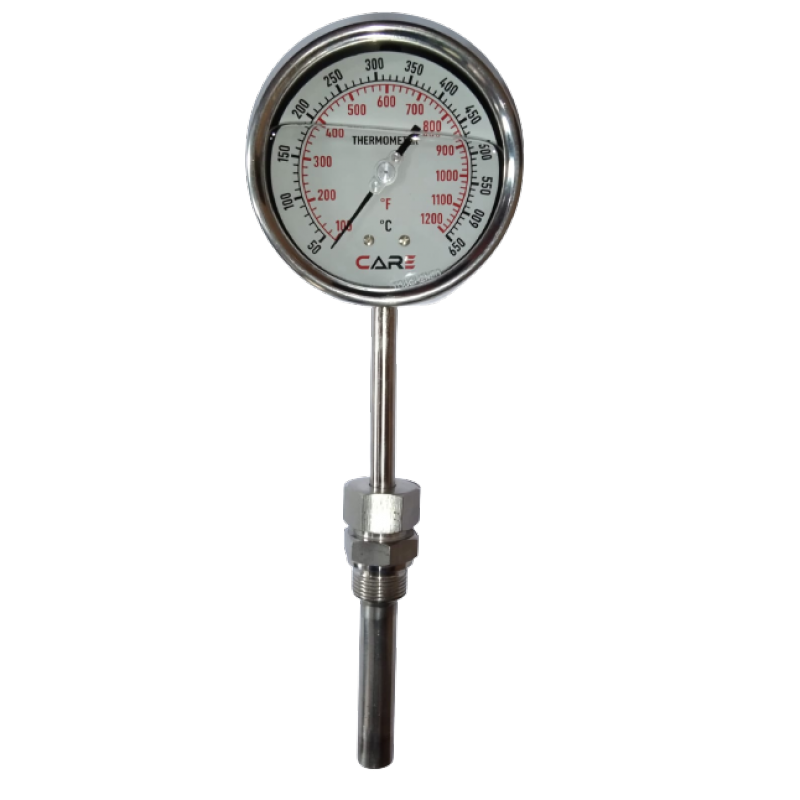
The Bi-Metal Temperature Gauge is available in nominal dial sizes of 63 mm, 100 mm and 150 mm. It can be supplied with a rigid stem in bottom-entry or back-entry construction. An every-angle rotatable version can also be offered for applications requiring greater flexibility in dial positioning and viewing.
The instrument is manufactured with an SS304 case, weatherproof protection, shatterproof glass window and an adjustable aluminium pointer. Stem material options include SS304 and SS316. Available temperature ranges cover applications from -20°C to 400°C, with a specified accuracy of ±1% of full-scale deflection.
CPI Technology Private Limited serves industrial buyers as a manufacturer, supplier and exporter of process instruments from Ahmedabad, Gujarat, India.
What Is a Bi-Metal Temperature Gauge?
A bimetal temperature instrument is a mechanical temperature-measuring device that uses the different thermal expansion characteristics of two bonded metals.
In this construction, the bimetal strip is formed into a helix. When the temperature surrounding the stem changes, the two metals expand at different rates. This difference produces mechanical movement in the helical sensing element.
The movement is transferred to the pointer mechanism, which indicates the measured temperature on the graduated dial.
Bimetal dial thermometers are valued for their simple and rugged construction. They are commonly selected for industrial applications requiring local temperature indication at a vessel, tank, pipeline, machine or process connection.
The gauge does not transmit an electronic signal. It provides a direct visual temperature reading at the installation point through the dial and pointer.
The available configurations allow the instrument to be selected according to:
-
Temperature range
-
Dial diameter
-
Stem material
-
Stem orientation
-
Process location
-
Viewing direction
-
Installation arrangement
The required configuration should be specified clearly when requesting a quotation.
Product Overview
The offered Bi-Metal Temperature Gauge is designed in accordance with the referenced EN 13190 standard.
It is available in three nominal dial sizes:
-
63 mm
-
100 mm
-
150 mm
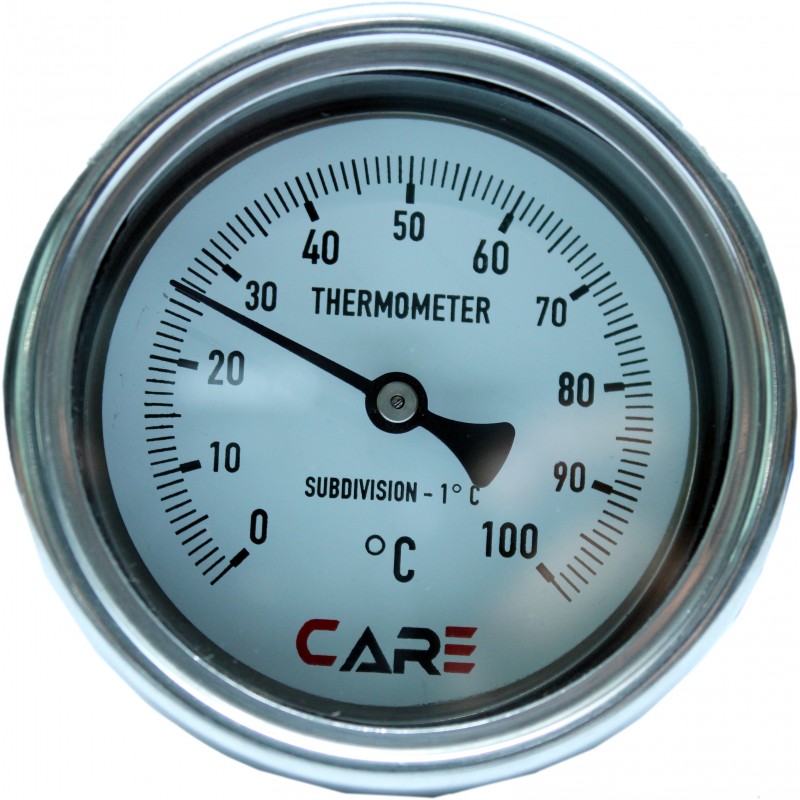
The dial is manufactured from aluminium with a white background and black markings for clear observation.
The case is manufactured from SS304 and provided with a bayonet bezel. The instrument has a weatherproof construction and a shatterproof glass window.
The pointer is manufactured from aluminium, finished in black and provided with a micrometer-adjustable arrangement.
The rigid sensing stem can be supplied in SS304 or SS316. Depending on the installation requirement, the instrument can be offered with:
-
Bottom entry
-
Back entry
-
Every-angle rotatable construction
The available measuring range extends from -20°C to 400°C, depending on the selected range configuration.
Key Features
-
Bimetal helical temperature-sensing element.
-
Simple and rugged mechanical construction.
-
Suitable for industrial temperature measurement.
-
Available temperature ranges from -20°C to 400°C.
-
Accuracy of ±1% of full-scale deflection.
-
Manufactured with reference to EN 13190.
-
Available in 63 mm, 100 mm and 150 mm nominal dial sizes.
-
Aluminium dial with white background.
-
Black dial graduations and markings.
-
SS304 case construction.
-
Bayonet bezel arrangement.
-
Weatherproof protection.
-
Shatterproof glass window.
-
Aluminium pointer with black finish.
-
Micrometer-adjustable pointer.
-
Rigid sensing stem.
-
SS304 or SS316 stem material options.
-
Available with bottom-entry construction.
-
Available with back-entry construction.
-
Every-angle rotatable construction can also be offered.
-
Suitable for local temperature indication in compatible industrial applications.
Technical Specifications
| Specification | Details |
|---|---|
| Product | Bi-Metal Temperature Gauge |
| Reference Standard | EN 13190 |
| Sensing Principle | Helical bimetal strip |
| Nominal Dial Sizes | 63 mm, 100 mm and 150 mm |
| Dial Material | Aluminium |
| Dial Background | White |
| Dial Markings | Black |
| Case Material | SS304 |
| Bezel Type | Bayonet bezel |
| Protection | Weatherproof |
| Window | Shatterproof glass |
| Pointer Material | Aluminium |
| Pointer Finish | Black |
| Pointer Adjustment | Micrometer adjustable |
| Stem Construction | Rigid stem |
| Stem Material | SS304 or SS316 |
| Entry Options | Bottom entry or back entry |
| Optional Construction | Every-angle rotatable |
| Temperature Range | -20°C to 400°C |
| Accuracy | ±1% of full-scale deflection |
| Primary Use | Local industrial temperature measurement |
Working Principle
The instrument uses a bimetal strip formed into a helical shape.
A bimetal element consists of two metals bonded together. Each metal responds differently when exposed to a change in temperature.
As the temperature rises or falls, the different expansion rates cause the bonded element to twist. In a helical construction, this movement is converted into rotational displacement.
The rotational movement operates the pointer, which travels across the graduated temperature scale.
The displayed value represents the temperature detected at the sensing stem.
The instrument should be installed so that the stem is exposed correctly to the temperature being measured. Incorrect stem positioning or insufficient insertion can affect the usefulness of the indicated reading.
The selected temperature range should also match the actual operating conditions.
Available Dial Sizes
The Bi-Metal Temperature Gauge is available in 63 mm, 100 mm and 150 mm nominal sizes.
63 mm Dial
The 63 mm version can be considered where installation space is limited and a compact dial is preferred.
The viewing distance and accessibility of the installation point should be considered before selecting this size.
100 mm Dial
The 100 mm version offers a balanced combination of dial visibility and installation size.
It is suitable for many general industrial applications where operators need a clear local temperature reading.
150 mm Dial
The 150 mm dial provides a larger display area.
It may be considered where the instrument must be observed from a greater distance or where a larger dial is preferred by the plant or project specification.
The final nominal size should be selected according to:
-
Available mounting space
-
Viewing distance
-
Equipment design
-
Operator access
-
Project specification
-
Required scale readability
Bottom-Entry Construction
In a bottom-entry design, the rigid stem extends from the lower portion of the gauge case.
This arrangement may be suitable where the gauge is installed vertically on the top of a vessel, pipeline, machine or process connection.
The dial normally faces the operator when the process connection is positioned below the instrument.
Before selecting bottom entry, the buyer should verify:
-
Instrument orientation
-
Process tapping location
-
Available vertical clearance
-
Required stem length
-
Viewing direction
-
Accessibility for installation and maintenance
The installation should allow the dial to remain visible after the stem is connected to the process.
Back-Entry Construction
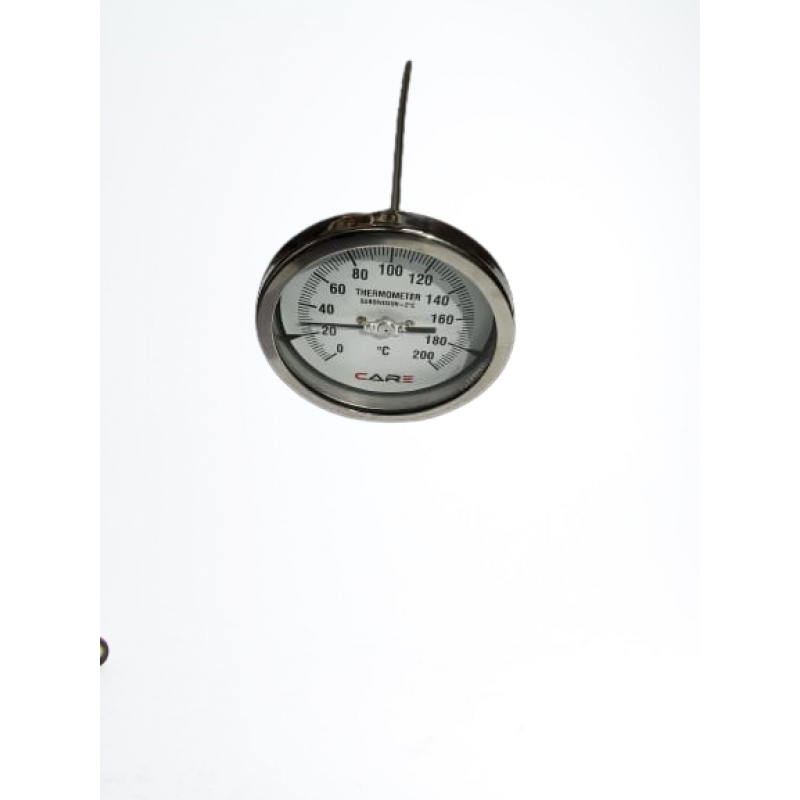
In a back-entry configuration, the rigid stem extends from the rear of the gauge case.
This construction may be selected where the instrument is mounted directly in front of the process connection or where the dial must face outward from the equipment.
Back entry can be considered for:
-
Equipment panels
-
Pipelines
-
Tanks
-
Skids
-
Machinery
-
Direct process mounting
The buyer should confirm that sufficient rear clearance is available for the stem and connection.
Every-Angle Rotatable Construction
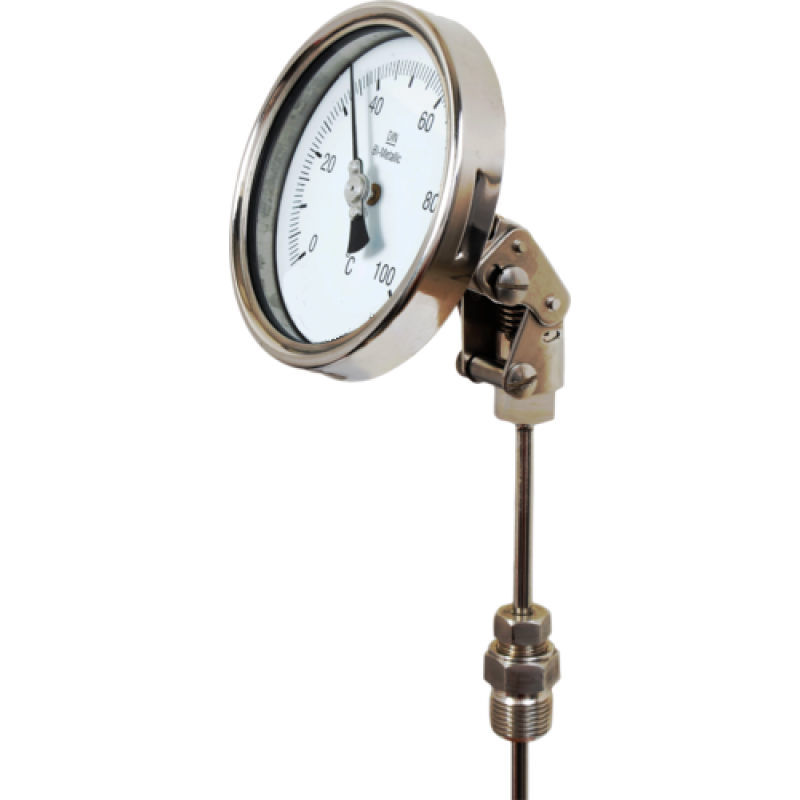
An every-angle rotatable construction can also be offered.
This configuration allows the dial position to be adjusted relative to the stem arrangement, supporting installations where the standard bottom-entry or back-entry orientation does not provide convenient viewing.
The rotatable arrangement may be useful where:
-
The process connection is installed at an angle.
-
The operator views the instrument from the side.
-
Pipe orientation prevents direct dial visibility.
-
Equipment design requires flexible positioning.
-
The installation point has restricted access.
The exact rotatable configuration and installation requirement should be stated in the enquiry.
Availability should be confirmed before order placement.
Stem Material Options
The sensing stem is available in SS304 or SS316.
SS304 Stem
SS304 may be selected for compatible general industrial applications.
Its suitability depends on the process medium, operating temperature and environmental conditions.
SS316 Stem
SS316 may be selected where the application requires the specified stainless steel grade or where improved compatibility with the process environment is required.
The buyer should not select the stem material only on the basis of temperature range.
The following should also be considered:
-
Process medium
-
Chemical composition
-
Corrosion conditions
-
Cleaning chemicals
-
Operating temperature
-
Hygienic requirement
-
Plant material specification
-
Project documentation
Final material compatibility remains the responsibility of the application review.
Temperature Range Selection
The instrument is offered in ranges covering temperatures from -20°C to 400°C.
The exact scale should be selected according to the minimum, normal and maximum process temperatures.
A range that is significantly higher than the actual operating temperature may make small temperature changes more difficult to observe.
A range that is too low may expose the instrument to temperatures beyond the selected full-scale limit.
For correct selection, the buyer should identify:
-
Minimum operating temperature
-
Normal operating temperature
-
Maximum operating temperature
-
Start-up temperature
-
Cleaning temperature
-
Temporary temperature excursions
-
Required scale unit
-
Preferred normal reading position
The selected measuring span should comfortably include the maximum expected operating condition.
The complete -20°C to 400°C statement represents the available overall range coverage. The required individual scale should be confirmed during product selection.
Accuracy
The specified accuracy is ±1% of full-scale deflection.
Because the accuracy is expressed as a percentage of the selected full-scale value, correct range selection is important.
For example, selecting an unnecessarily high scale can increase the absolute value represented by the ±1% accuracy specification.
Engineering teams should therefore select a range that accommodates the process while remaining reasonably close to the actual operating temperatures.
The instrument should be installed, handled and used according to approved plant procedures.
Where calibration documentation or traceability is required, this should be stated separately in the enquiry.
Dial and Pointer Construction
The dial is manufactured from aluminium and has:
-
White background
-
Black markings
-
Graduated temperature scale
The contrast between the white dial and black markings supports clear local observation.
The pointer is manufactured from aluminium and finished in black.
It is provided with a micrometer-adjustable arrangement.
The pointer should be adjusted only by authorized personnel and according to the relevant instrument procedure. Incorrect adjustment can cause the displayed value to differ from the actual temperature.
Case and Bezel
The case is manufactured from SS304.
The instrument is supplied with a bayonet bezel arrangement.
The stainless steel case provides a rugged enclosure for the internal measuring mechanism.
The bayonet bezel supports assembly of the case, window and dial arrangement.
The suitability of the case for a particular environment should be evaluated according to the declared weatherproof construction and the actual installation conditions.
Weatherproof Protection
The gauge is specified as weatherproof.
This construction supports use in compatible industrial locations where the instrument may be exposed to normal environmental conditions.
The term weatherproof should not automatically be interpreted as suitability for:
-
Continuous submersion
-
High-pressure washdown
-
Corrosive atmosphere
-
Hazardous area installation
-
Extreme vibration
-
Unspecified ingress-protection requirements
Where a project requires a specific IP rating, hazardous-area certification or environmental classification, the requirement should be mentioned separately for verification.
Shatterproof Glass Window
The instrument is provided with a shatterproof glass window.
The window protects the dial and pointer while allowing the temperature reading to remain visible.
The window should be kept clean and protected from direct mechanical impact.
The installation location should allow the operator to inspect the dial without obstruction.
Applications
The Bi-Metal Temperature Gauge is used for local temperature measurement in a wide range of compatible industrial applications.
Typical applications may include:
-
Storage tanks
-
Mixing vessels
-
Process vessels
-
Reactors
-
Pipelines
-
Heat exchangers
-
Boilers
-
Heating systems
-
Cooling systems
-
Industrial ovens
-
Dryers
-
Process skids
-
Utility equipment
-
Water-treatment systems
-
Food-processing machinery
-
Pharmaceutical equipment
-
Chemical-processing equipment
-
Industrial machinery
-
Oil and lubricant systems
-
OEM equipment
Actual suitability depends on the process temperature, medium, stem material, insertion arrangement, process connection and environmental conditions.
Industries Served
The Temperature Gauge can be considered for use across industries such as:
-
Chemical processing
-
Pharmaceutical manufacturing
-
Food and beverage processing
-
Dairy processing
-
Water and wastewater treatment
-
Oil and gas equipment
-
Petrochemical processing
-
Power generation
-
Utility systems
-
HVAC equipment
-
Boiler manufacturing
-
Process equipment manufacturing
-
Industrial machinery manufacturing
-
Packaging machinery
-
Engineering procurement and construction
-
Factory maintenance
-
OEM equipment manufacturing
Each application should be reviewed against the selected range, material and mounting configuration.
Buyer Benefits
Rugged Mechanical Construction
The bimetal sensing principle and stainless steel case provide a simple and rugged arrangement for local temperature indication.
Wide Temperature Coverage
Available range options cover industrial temperature requirements from -20°C to 400°C.
Multiple Dial Sizes
The availability of 63 mm, 100 mm and 150 mm sizes allows the gauge to be selected according to space and viewing requirements.
Flexible Entry Options
Bottom-entry and back-entry configurations support different process and equipment layouts.
Rotatable Construction Option
An every-angle rotatable version can be offered where the dial must be repositioned for convenient viewing.
Stainless Steel Stem Options
SS304 and SS316 stem materials allow buyers to select the required construction according to the application specification.
Clear Analogue Display
The white aluminium dial, black markings and black pointer provide a clear local temperature indication.
Adjustable Pointer
The micrometer-adjustable pointer supports controlled pointer adjustment where permitted by the applicable procedure.
Weatherproof Construction
The weatherproof enclosure supports use in compatible industrial installation environments.
Defined Accuracy
The ±1% FSD specification provides buyers with a clear reference for technical evaluation.
Installation Considerations
Correct installation is essential for meaningful temperature indication.
The engineer should verify:
-
Required temperature range
-
Stem material
-
Stem length
-
Stem diameter
-
Entry orientation
-
Process connection
-
Insertion depth
-
Dial size
-
Viewing direction
-
Process medium
-
Operating temperature
-
Ambient conditions
-
Equipment vibration
-
Accessibility
The sensing portion of the stem should be adequately exposed to the process temperature.
If the insertion length is insufficient, the stem may not represent the actual process temperature accurately.
The gauge should be installed using appropriate fittings and according to plant safety procedures.
The case should not be used as a lever while tightening the process connection.
Information Required for Quotation
To receive a technically suitable and commercially accurate quotation, buyers should provide:
-
Required temperature range
-
Minimum operating temperature
-
Normal operating temperature
-
Maximum operating temperature
-
Required nominal dial size
-
Stem material: SS304 or SS316
-
Bottom-entry or back-entry construction
-
Every-angle rotatable requirement, if applicable
-
Required stem length
-
Required stem diameter
-
Process connection
-
Process medium
-
Installation location
-
Quantity
-
Delivery location
-
Export destination, where applicable
-
Calibration requirement, if any
Complete information helps ensure that the offered configuration matches the installation requirement.
Why Choose CPI Technology Private Limited?
CPI Technology Private Limited is a manufacturer, supplier and exporter of industrial process instruments based in Ahmedabad, Gujarat, India.
We serve plant operators, original equipment manufacturers, engineering contractors, consultants, system integrators and procurement departments.
Application-Based Selection
Selection depends on temperature range, dial size, stem material, entry orientation and process conditions.
Our team reviews the submitted technical requirement before preparing the offer.
Manufacturer and Supplier in Ahmedabad
Our Ahmedabad location supports customers across Gujarat and other industrial regions of India.
Buyers may submit product data sheets, instrument lists, equipment specifications or project bills of quantities.
Support for OEM Requirements
We work with equipment manufacturers that require temperature instruments for tanks, vessels, pipelines, skids and machinery.
Different dial sizes, stem materials and mounting orientations can be reviewed according to the OEM requirement.
Export Supply from India
CPI Technology Private Limited also addresses enquiries from overseas distributors, project companies and machinery manufacturers.
Export customers should provide the required quantity, destination and complete technical specification.
Clear Technical Documentation
We present product specifications in a structured format to assist engineering and procurement teams during technical evaluation.
Any requirement not included in the confirmed specification is treated as subject to verification.
Temperature Gauge Supplier in Gujarat
Industrial buyers in Ahmedabad, Vadodara, Ankleshwar, Bharuch, Surat, Vapi, Rajkot and other manufacturing regions can submit enquiries for bimetal temperature instruments.
We support requirements from:
-
Process plants
-
Tank manufacturers
-
Vessel manufacturers
-
Boiler manufacturers
-
Equipment fabricators
-
Automation contractors
-
Utility companies
-
Engineering consultants
-
OEM machinery manufacturers
-
Industrial distributors
The final configuration will depend on the required temperature range, dial size, stem material and installation arrangement.
Request a Quotation
For pricing and availability, send us the required temperature range, dial size, stem material, entry type, stem dimensions, process connection, quantity and delivery location.
The instrument is available with a rugged bimetal helical sensing element, SS304 case, shatterproof glass window and an accuracy of ±1% FSD.
CPI Technology Private Limited will review the submitted details and provide a suitable technical and commercial proposal.
Frequently Asked Questions
1. What is the working principle of a Bi-Metal Temperature Gauge?
It uses a bimetal strip formed into a helix. Temperature changes cause the two bonded metals to expand differently, producing movement that operates the dial pointer.
2. What temperature range is available?
Available ranges cover temperatures from -20°C to 400°C. The exact individual measuring span should be selected according to the application.
3. What is the accuracy of the Temperature Gauge?
The specified accuracy is ±1% of full-scale deflection.
4. Which dial sizes are available?
The available nominal dial sizes are 63 mm, 100 mm and 150 mm.
5. Which stem materials can be supplied?
The rigid stem can be supplied in SS304 or SS316.
6. Is the gauge available in bottom-entry and back-entry configurations?
Yes. It can be offered with a rigid stem in bottom-entry or back-entry construction.
7. Can the dial position be adjusted?
An every-angle rotatable construction can also be offered for installations requiring flexible dial positioning. Availability should be confirmed when ordering.